
360° tours and digital twins: the new real estate standard
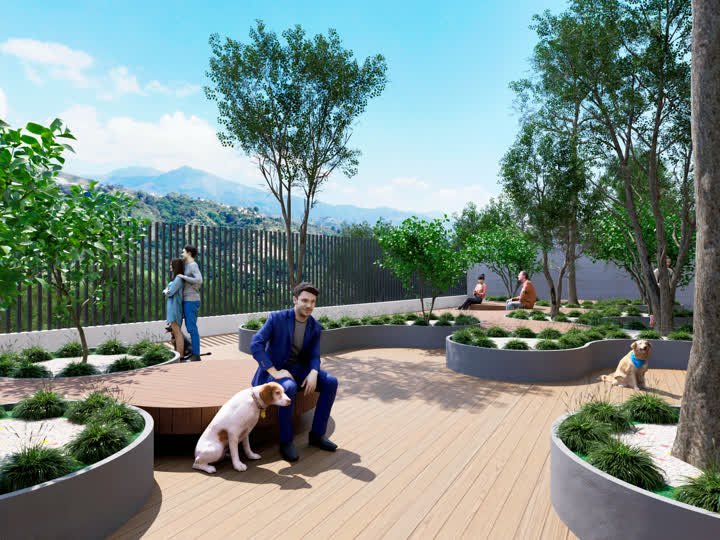
Going from a 2D plan to a 3D model changes one fundamental thing: interpretation disappears. 360° tours and digital twins, the virtual replica of the project, work at both ends of the business: selling better and building with fewer errors.
Want to see this on your project? Book a free demo
What each one is
A digital twin is the complete 3D replica of the project: the building, every unit type, the amenities and the surroundings, built from the drawings. You walk through it in real time, you can change its finishes, and it serves both the team that designs and builds and the team that sells.
A 360° tour is one of the assets that come out of that model: panoramic images taken from fixed points, which the buyer turns with a finger or a mouse. It's light, opens in any browser and works very well for first contact.
| 360° tour | Digital twin | |
|---|---|---|
| How the user moves | Jumps between fixed points and turns the view | Walks freely through the whole project |
| Changes | What's shown is already set | Finishes, time of day and floor, on the spot |
| Where it opens | Any browser, even on a slow connection | In the sales room or, with pixel streaming, in any browser |
| Best used for | Ads, social media and the first WhatsApp message | Visits, video calls, design and construction decisions |
Verify before building
On a complete model the conflicts surface on their own: the duct clashing with the beam, the headroom that falls short, the door that opens into the cabinet. And since architects, engineers, sales and management all look at exactly the same thing, the discussion is about facts, not interpretations.
Sell with clarity
For the buyer, a 360° tour removes the ambiguity: they move through the spaces, grasp the real proportions and picture themselves living there. And whoever understands, decides faster.
Optimize resources
Seeing the whole project before building it brings order to spending: fewer corrections, better cost control and savings that add up across the build. Every review is recorded in minutes and on video, so it's always clear what was decided and when.
When the whole team looks at the same model, the discussion stops revolving around how to read a drawing.
With Vista D360 we turn plans, images and renders into a detailed 3D model, and review it with your team before construction starts.
That same model is what powers the virtual sales room.
From drawings to model, step by step
- The information: architectural drawings, elevations, finish specifications and the exact location of the site.
- The model: the building, every unit type and the surroundings are built with their real height and orientation.
- Materials and light: the specified finishes and lighting that behaves like the real thing at every hour.
- The review: the team walks through the model, conflicts are fixed and pending decisions are made.
- The assets: renders, video, 360° tours and the virtual sales room all come from the same file.
What each area gains
- Management: faster decisions, because everyone discusses the same thing.
- Design and construction: conflicts show up on screen, while fixing them is still cheap.
- Sales: material ready from launch day, before the physical sales room exists.
- The buyer: understands what they are buying and no longer depends on imagination.
- After-sales: a clear record of what was shown, which avoids disputes at handover.
To see how this changes with the size of the project, we explain it in digital twins for small, medium and large projects, and tours in detail in 360° virtual tours.
Mistakes worth avoiding
- Modeling from half-finished drawings. Every later change gets paid for twice: in the design and in the model.
- Treating it as a sales tool only. If the technical team doesn't use it to review the project, half its value is lost.
- Delivering images only. If the model isn't available to walk through, buyers go back to relying on their imagination.
- Not keeping it updated. A model that doesn't reflect the latest changes creates distrust instead of resolving it.
Frequently asked questions
What is a digital twin in real estate?
It's the complete 3D replica of a real estate project, built from its drawings, that you walk through in real time. It's used to review the design before construction and to show buyers the finished project while it doesn't exist yet.
What is a 360° virtual tour?
It's a set of panoramic images of the project, taken from fixed points, that the buyer turns with a finger or a mouse from any browser.
What's the difference between a 360° tour and a digital twin?
In a 360° tour the user jumps between fixed points; in a digital twin they walk freely, change finishes and look out from any floor. The 360° tour comes out of the digital twin, so you don't have to choose one or the other.
Is a digital twin worth it for a small project?
Yes. The model scales to the size of the project, and in a small one it also prevents design errors and gives the sales team material to sell from day one.
Ready to accelerate the sale of your project?
Discover how a virtual sales room can transform your marketing.
Request a demo